
How to programme wellness at a conference so people actually show up
Most conference wellness gets poor attendance because it is squeezed into a schedule with no room for it. It works when it gets a real slot, asks nothing physical of anyone, and fits the culture of the room. Here is what six years of doing it, in rooms of thirty to three thousand, has taught us.
Pause + Expand · Updated September 2026
Everyone wants it. Nobody has worked out how to do it yet.
Wellness is on every conference agenda now, and it is still new in the way it gets put there. How much time it needs, which topics work, what space it takes, where it goes in the day, whether it is even smart to do at all: none of that is settled, and most practitioners cannot tell you either.
It is a bit like knowing you should eat better without knowing what to cook. Planners know they want wellness programming. What is missing is how to do it properly.
The attendees are ahead of the programmes. In Hilton's 2026 study, 67% of attendees said they feel less engaged at events without downtime, and 55% skip sessions to recover when no breaks are planned.
Give it a slot, not a gap
The usual mistake is programming wellness against a schedule that has no room for a bathroom break. Then it gets poor attendance, and the conclusion is that wellness does not work at conferences. It does. It was never given a chance.
The worst slot is the one squeezed between something people want to get out of and something they want to get to. End of day, right before the cocktail hour, is the most common example. Nobody is going to slow down when the bar is opening.
The best slot is just before a break, earlier in the day, and always before people eat. Skift Meetings made the same case this month: a fifteen-minute break before a keynote is what lets people take in the keynote.
Source: Skift Meetings, The 15 Minutes Every Conference Needs, September 2026
How much time it needs
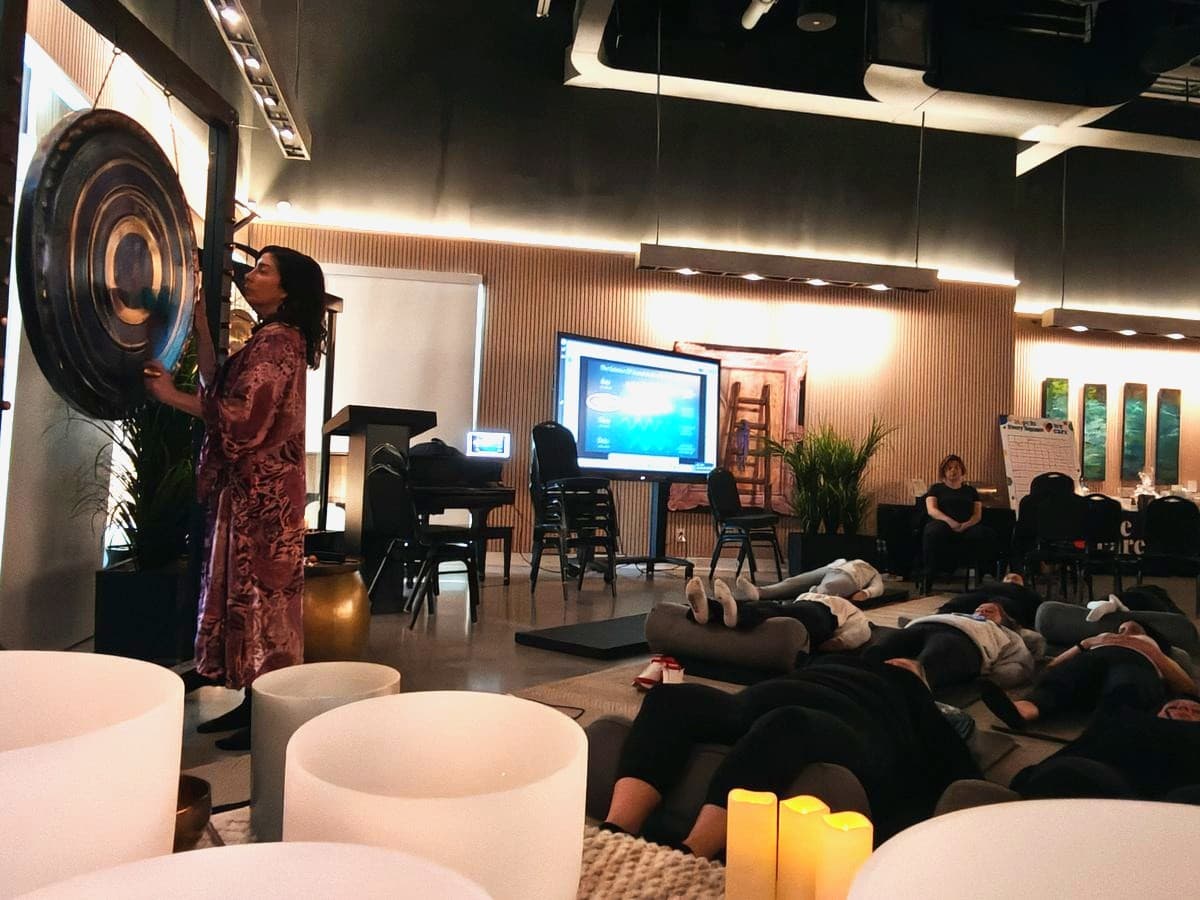
Twenty minutes is enough for a reset between speakers, right in the room. An hour is a keynote that ends in a live sound bath. A day is a wellness room people drop into during the white space in the agenda.
Twenty minutes is the shortest slot we will take. Anything less is a waste of your money, and it is better to move something in the schedule than to shrink this.
The themes that work now
The themes are changing, and the ones landing this year are about the pace of the day. Taking a break from AI. Finding space in a day when technology lets us do so much. Work-life balance seen as energy: you are a battery, and there is only so much in it.
The other one is simpler than any of those: learning to meditate. Following your thoughts, accepting that everyone has a busy mind, and making it easy. We can have a room meditating within a minute.
For a short slot, the best topic is the simplest one. The most important business skill there is, is being aware of your thoughts and how they are shaping your work. Twenty minutes is enough to show a room what that means.
Ask nothing physical of anyone
In a hall of a few hundred, people stay at their tables, in whatever they wore, and nobody is asked to move. We do that on purpose: the moment you ask a room to do something with its body, you have given half of it an excuse to leave.
That is why meditation, mindfulness and sound work in rooms where yoga at seven in the morning does not. All anyone is asked for is a little time given to the thought of slowing the mind down.
Which rooms it works in, and which it doesn't
It works best in rooms that are open to the idea, and in cultures where honesty is normal. In some company cultures it can feel forced, and forcing it is worse than skipping it.
The way to know is to ask. Who is in the room, what has the year been like for them, and what does the day need? That is the first conversation we have with a planner, and sometimes the honest answer is a lighter session, or not this time.
Is it smart to do it at all?
Not always. If the schedule has no real slot, the room is not ready, or the budget only stretches to ten minutes at the end of the day, it is smarter not to. We will tell you that before you sell it to your client.
Also asked
- What does the venue need?
- Microphones, and the sound system already in the room. We plug into what is there and work with your AV team.
- Why do people leave a wellness session, and how do you stop it?
- Two reasons: they do not know what is about to happen, or they think there is a religious side to it. We open by saying plainly what the next twenty minutes are and are not, and nobody is asked to share or believe anything.
- Does it work in a hall of hundreds?
- Yes. People stay at their tables in their own clothes. Nothing is asked of them physically.
- Can we choose the theme?
- Yes. We shape it with you to fit the day, from taking a break from AI to simply learning to meditate.