
What a sound bath does to a busy mind
A sound bath gives a busy mind something easy to rest on. Instead of trying to empty your head, you listen, and long bowl tones hold your attention while your body slows down. In small studies, people felt less tense, angry and tired afterwards. Played live, and heard on headphones, it works over Zoom too.
Pause + Expand · Updated September 2026
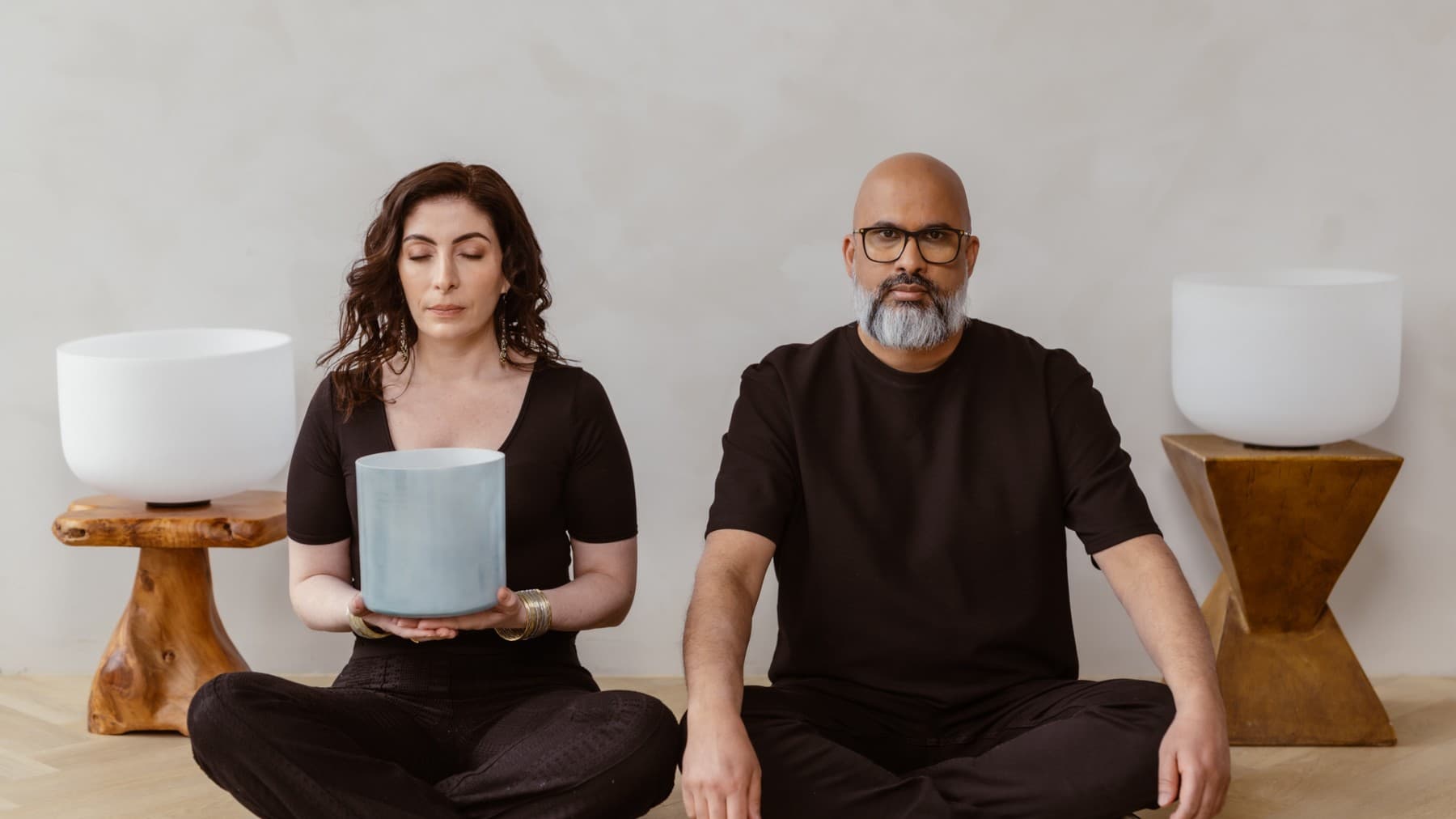
Listening is easier than emptying your mind
Most meditation asks a busy mind to do the one thing it finds hardest: go quiet. A sound bath asks for something easier. You listen. Long, slow tones fill the space around you, and your attention has somewhere to rest that takes no effort at all.
After a first sound bath, we hear two things again and again. People who never thought they could slow their mind down say: I didn't think that could happen. I've never been able to slow my thoughts down. And people who have meditated for years say it is the deepest calm they have felt in so short a time.
What the research says
In a 2017 study of 62 adults, people reported much less tension, anger, fatigue and low mood after a singing bowl meditation. The people who had never tried one before had the biggest drop in tension.
Source: Goldsby and others, Effects of Singing Bowl Sound Meditation on Mood, Tension, and Well-being, 2017
The honest part: the science is young
That study used metal bowls, in person, and had no comparison group. A 2020 review found only four studies on singing bowls in total. They all pointed the same way, toward less anxiety and tension, but there were too few for the researchers to call it a proven therapy yet.
We would rather tell you that plainly than promise what the science has not shown. What we can tell you is what we have seen over more than 800 live mornings.
Source: Stanhope and Weinstein, The Human Health Effects of Singing Bowls: A Systematic Review, 2020
Why crystal bowls
Honestly, because of the sound. We love the way they sound. To our ears, crystal bowls are far more calming than brass Tibetan bowls or copper bowls.
Why we play it live
A recording is the same every time. A live sound bath is not a one size fits all performance. When we play, we are playing to the energy of the room and to what the morning's theme needs, and that ability to sense the room and follow it is the whole point.
Sometimes a morning starts with a theme about excitement, and then we learn that someone is in grief, or going through pain. So we change it. The sound slows, the theme shifts, and the whole room rallies around the person who needs it.
What it looks like when a body lets go
In a physical room you can watch it happen. Bodies slow down. People who walked in with their arms crossed end up lying flat on the floor.
We help it along. Partway through we will ask: can you uncross your arms? Can you uncross your legs? Small things, and the body takes the hint.
Does a sound bath work over Zoom?
Yes, with headphones. Most of our members use them, because the sound is so much richer and more alive in stereo, moving around you rather than coming at you from a laptop.
We have played live over Zoom twice a week since March 2020. Each of our bowls was captured with studio microphones so that it survives the internet, and every tone is still played in the moment, for that morning's room.
Also asked
- Do sound baths work online?
- Yes, when they are played live and you listen on headphones. We have run them over Zoom twice a week since March 2020.
- Headphones or laptop speakers?
- Headphones. Speakers work, but headphones put the sound all around you, in stereo.
- What does a sound bath do to your brain?
- The honest answer is that the research is still early. What studies have measured is that people feel less tense, angry and tired afterwards.
- What if I get emotional?
- That is welcome. Sometimes people arrive carrying grief or pain, and we shape the morning around whoever needs it.